
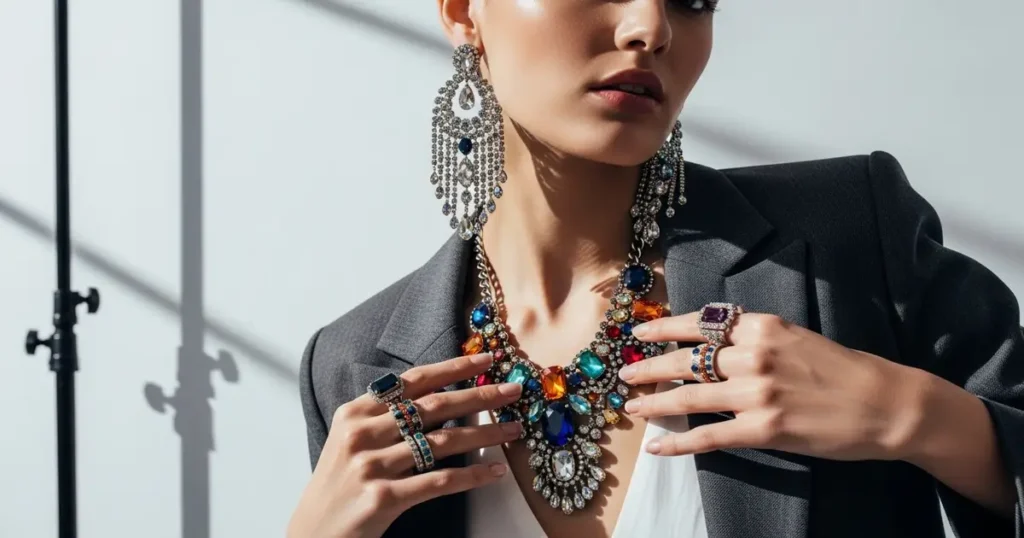

Costume jewelry occupies a fascinating space in the fashion world. When Coco Chanel and Elsa Schiaparelli popularized non-precious jewelry in the 1920s and 1930s, they were not trying to deceive anyone into believing they were wearing genuine diamonds or natural pearls. Instead, they championed fashion jewelry as an art form in its own right—a way to wear dramatic, architectural, and colorful designs without the astronomical price tag or stuffy conventions of high jewelry.
Over the past two decades, fast-fashion manufacturing has muddied those waters. Shelves are flooded with disposable pieces made from lightweight zinc alloys, brittle plastic, and microscopically thin plating designed to tarnish after two wears. Yet true high-end costume jewelry remains one of the smartest investments a style-conscious buyer can make. Masterfully crafted fashion pieces can endure for decades, commanding attention on the runway or holding their value on the vintage market.
Separating collectible, durable fashion jewelry from throwaway retail filler requires looking beyond the brand label. You have to inspect the piece like a bench jeweler, evaluating its physical weight, stone settings, metalwork, and mechanical findings.
Metalwork, Density, and Surface Finishing
The foundation of any piece of jewelry is its base metal. Low-end contemporary costume jewelry is typically cast from cheap zinc alloys or hollow aluminum. These metals feel featherlight in the hand, warm up to body temperature almost immediately, and are prone to snapping under even slight pressure.
High-grade costume jewelry, whether vintage or contemporary, relies on substantial base metals such as solid brass, bronze, copper, or lead-free pewter. These metals provide tangible heft. When you pick up a well-made collar necklace or cuff bracelet, it should feel cold to the touch and noticeably dense. That physical weight ensures the piece drapes correctly against the collarbone or stays anchored to the wrist rather than sliding around awkwardly.
Examine the smoothness of the metal surface under good lighting. Cheap jewelry is mass-produced using low-pressure die-casting, which leaves behind pitted surfaces, air bubbles, and prominent mold seams along the edges. Quality pieces undergo rigorous hand-finishing, tumbling, and polishing before any plating is applied. The edges should feel rounded and smooth against your skin, with no sharp flashings or casting lines left behind by the mold.
Plating thickness is the ultimate dividing line between longevity and quick discoloration. Bargain pieces receive flash plating—a microscopic wash of gold or silver that can rub off against skin or clothing within weeks. Superior costume jewelry features electroplating that measures several microns thick, often labeled as heavy gold electroplate or vermeil. Look for a deep, rich luster rather than an overly brassy, hyper-reflective yellow sheen, which usually indicates thin lacquer applied over raw, unpolished base metal.
Stone Quality: Glass Crystals Versus Molded Plastic
The stones set into costume jewelry determine its brilliance and clarity. Bargain pieces utilize injection-molded acrylic or polystyrene rhinestones. While plastic stones look passable under store spotlights, they quickly show their weaknesses in natural daylight. Plastic has a low refractive index, meaning it reflects light flatly rather than breaking it into sharp, prismatic flashes. Furthermore, plastic scratches easily when exposed to keys, makeup, or perfume, becoming cloudy over time.
Exceptional costume jewelry relies on high-lead glass crystals, paste stones, or mineral cabochons. Austrian crystals, historical French paste, and Czech glass feature machine-cut or hand-beveled facets with knife-sharp edges that refract light with fiery intensity. When you touch a crystal stone, it should feel cool against your cheek; acrylic always feels lukewarm.
Pay close attention to how the stones are backed:
-
Foil backing: High-quality glass rhinestones traditionally feature a silver or gold mirrored foil back applied behind the pointed pavilion of the stone to maximize light reflection. In superior pieces, this foil is sealed with a protective gray or green lacquer to prevent moisture from causing dark, dead spots known as stone rot.
-
Open-back mountings: Stones in exceptional pieces are sometimes mounted in open-backed settings, allowing light to pass directly through the glass. This technique is reserved for top-tier crystals with flawless clarity, as open mounts immediately expose internal bubbles or flaws that cheap manufacturers try to hide with opaque foil.
-
Unfoiled specialty glass: High-end makers frequently use art glass such as poured glass, art glass cabochons with swirling color inclusions, or opalescent stones. These materials have depth and three-dimensional character that injection-molded resin can never replicate.
Setting Techniques: Prongs Versus Adhesives
How stones are secured into their metal mountings reveals more about manufacturing standards than almost any other detail. Cheap fashion jewelry relies almost exclusively on industrial glue. Stones are simply pressed into shallow, pre-cast cavities filled with adhesive. Over time, exposure to body heat, sweat, and humidity degrades the glue, causing stones to pop out and disappear.
High-caliber costume jewelry mimics fine jewelry construction by securing stones with mechanical prong settings.
Look closely at the tiny metal prongs holding each stone:
-
True working prongs: On fine pieces, the prongs are bent firmly over the girdle of the stone, physically locking it into the metal cup.
-
Faux prongs: Dishonest manufacturers often cast fake, decorative prongs into the metal bezel and glue the stone on top of them. If the prongs do not make physical contact with the top edges of the stone, they are purely decorative, and glue is doing all the work.
-
Bezel and channel settings: Premium costume designs frequently feature stones hand-set into continuous metal collars or channels, which require skilled labor and provide immense durability.
When glue is used legitimately—such as in faux pearl settings or intricate pavé work—examine the precision of the application. In low-tier production, you will see messy glue seepage pooling around the edges of the stones, often yellowing with age. In high-end work, adhesive is applied with pinpoint accuracy, leaving the stones clean, upright, and free of cloudy residue.
The Architecture of the Reverse Side
Turn the piece over. The back of a jewelry item reveals the manufacturer’s true commitment to craftsmanship, away from the glittering distraction of the front.
Inferior pieces feature hollow, scooped-out reverses designed to save metal weight, leaving sharp edges that bite into the skin. The plating on the back is often uneven, dull, or entirely neglected.
Conversely, masterfully crafted costume jewelry treats the reverse side with the same respect as the front:
-
Textured and patterned backs: Look for finished textural patterns such as cross-hatching, basket weaves, stippling, or a refined Florentine brush finish. This detailing hides minor surface scratches, ensures a comfortable feel against bare skin, and indicates a custom casting mold.
-
Smooth, snag-free solder points: Inspect the joints where components connect. High-end pieces feature neat, fluid solder seams that have been polished smooth. If you see clumpy, messy blobs of solder or raw wire ends, the piece was rushed through assembly.
-
Clothing safety: Run the back of the piece across a fine knit or a piece of silk. A well-crafted item will glide effortlessly across delicate fabric without catching, pulling threads, or scratching your skin.
Mechanical Hardware and Articulation
Jewelry is meant to move with the body, which requires sound mechanical engineering. The hinges, clasps, links, and safety catches are the primary failure points on poorly made pieces.
Begin by testing the articulation of multi-link necklaces and bracelets. Each link should be connected through individual, hand-assembled jump rings or internal hinges. When you drape the piece over your fingers, it should flow like liquid ribbon. If the links bind, stiffen, or twist awkwardly, the casting tolerances are sloppy.
Examine the jump rings connecting the various elements:
-
Soldered rings: On superior costume jewelry, every jump ring is fully soldered shut, creating a continuous loop of metal that cannot pull open when snagged.
-
Unsoldered split rings: Cheap pieces leave jump rings with a visible open seam. A single firm tug will bend the ring open, sending the necklace clattering to the floor.
Inspect the functional clasps and fasteners:
-
Necklaces and bracelets: Look for substantial fold-over clasps, tongue-and-groove box clasps with audible clicks, or well-sprung lobster claws. Luxury costume bracelets often include an attached figure-eight safety catch or an auxiliary safety chain.
-
Brooches and pins: The pin mechanism should feature a substantial steel pin stem anchored by a sturdy joint and secured with a fully functioning rollover safety clasp. A simple, open C-clasp that allows the pin to slip out under pressure is a hallmark of cost-cutting.
-
Earrings: Quality clip-on earrings feature paddle or French clips with tension adjustments and smooth, rounded pads to distribute pressure evenly without pinching. Pierced earrings should feature surgical steel, titanium, or sterling silver posts soldered securely to the setting, rather than base metal posts glued to the back.
Hallmarks, Signatures, and Maker’s Marks
While an unsigned piece can certainly possess fine craftsmanship, signatures provide immediate insight into quality standards. Renowned costume houses maintained stringent quality control protocols that independent fast-fashion brands rarely match.
Inspect the piece with a jeweler’s loupe or your smartphone’s macro lens. Look for maker’s marks stamped directly into the metal or applied via a soldered metal plaque on the reverse side. Prestigious vintage makers like Trifari, Kenneth Jay Lane, Boucher, Miriam Haskell, Christian Dior, and Schreiner held their production to the exacting standards of fine jewelry houses. Many pieces from the mid-twentieth century even feature design patent numbers stamped into the findings, indicating unique, proprietary mechanical designs.
Modern luxury labels continue this tradition. High-end runway jewelry from design houses often carries oval plaques stamped with the brand’s logo, origin of manufacture, and seasonal collection codes.
Learning to evaluate costume jewelry through the lens of construction frees you from the cycle of buying disposable accessories that turn your skin green and end up in landfills. When you prioritize substantial base metals, authentic prong-set glass crystals, hand-finished reverses, and robust mechanical hardware, you build a collection of statement pieces that look magnificent, move gracefully, and retain their luster for a lifetime.
